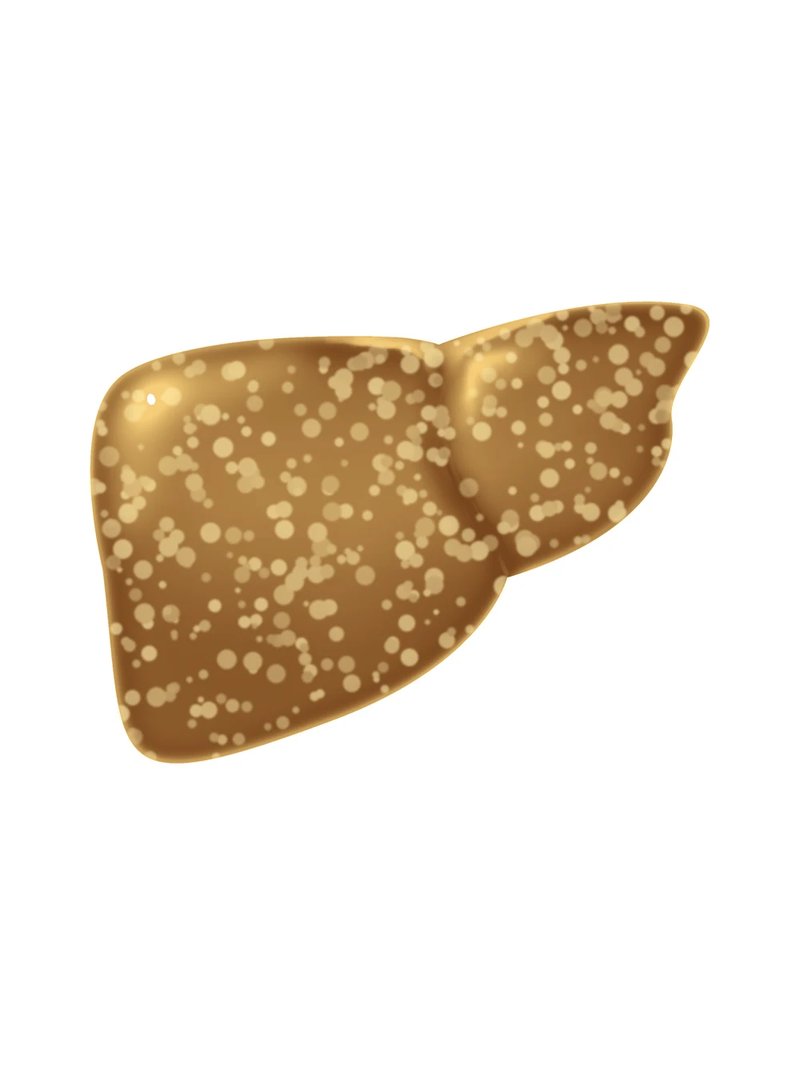
Models of human organs, with the liver in the foreground.Illustration of a fatty liver with fat droplets

Original publication: Bedogni G, Bellentani S, Miglioli L, et al., BMC Gastroenterol, 2006

FLI (Fatty Liver Index)

Do I have fatty liver disease?

Using 4 pieces of information (weight, height, waist circumference and two blood test results), in under a minute, this tool estimates the likelihood of a fatty liver using the FLI index. It is intended for adults with a recent blood panel on hand. The result distinguishes three zones: fatty liver unlikely, an intermediate zone, or fatty liver likely.

Estimate the likelihood of having a fatty liver (hepatic steatosis) from your waist size, your BMI and two results from a routine blood test.

4 pieces of information · under 1 minute · Free, no sign-up

Please read before you start: this guidance tool does not replace a medical consultation. It does not provide a diagnosis.

  • A low or normal result does not rule out the need to see a doctor if you have another symptom that this specific test does not cover.
  • Depending on your age or the guidelines in your country, a consultation may still be advisable even with a negative result.

Ready to start?

4 pieces of information, under 1 minute.

⚠️ You'll find triglycerides and gamma-GT on a recent blood panel. If you don't have them, your doctor can prescribe them.

Before you start

Who is it for?

Adults with a recent blood panel on hand.

What you'll need

your weight, your height, your waist circumference, and two blood test results (triglycerides, GGT).

What you'll get

a likelihood of fatty liver (hepatic steatosis).

How to read your result

The result distinguishes three zones: fatty liver unlikely, an intermediate zone, fatty liver likely. Only an imaging exam, most often an ultrasound, can confirm a fatty liver; a high result may lead you to consider the FIB-4 test, offered at the end.

🔒 No signup, no data stored✓ Content based on medical studies

You might also be interested in

Fatty liver disease in a few words

Read the article ▾

What is hepatic steatosis?

Hepatic steatosis, sometimes called "fatty liver disease," is an excessive buildup of fat in liver cells. It is now strongly associated with metabolic syndrome: overweight or obesity, type 2 diabetes, high blood pressure, and lipid panel abnormalities are all very common in people affected by it.

Why it's often silent

Hepatic steatosis usually causes no symptoms at an early stage. It is most often discovered incidentally, during a routine blood test or an abdominal ultrasound done for another reason. It is precisely because it is silent that a simple screening tool like the FLI is useful: it helps identify people for whom an imaging exam is most likely to be worthwhile.

How the FLI works

The FLI combines 4 pieces of information that are easy to obtain: BMI, waist circumference, and 2 blood test results (triglycerides and GGT). It produces a score from 0 to 100. A low score makes a fatty liver unlikely; a high score makes it likely, without formally confirming it — that's where an ultrasound comes in, the only exam able to directly visualize fat in the liver.

After a high result? The question of fibrosis

A fatty liver on its own is most often benign and reversible with lifestyle changes. The real risk appears when the associated inflammation leads, over time, to fibrosis: a progressive buildup of scar tissue. This is a separate question from "do I have a fatty liver?", for which another validated score exists, the FIB-4 — offered at the end of this test if your result suggests it.

The limits of this score

The FLI is a screening tool, not a diagnostic one: it estimates a likelihood, not a certainty. Like any score built on population data, it can be wrong at the individual level — a result in the intermediate or high zone deserves a conversation with a doctor rather than being interpreted on its own.


Frequently asked questions

What is the FLI (Fatty Liver Index)?

The FLI (Fatty Liver Index) is a screening score, calculated from BMI, waist circumference, and 2 blood test results (triglycerides, GGT), that estimates the likelihood of having a fatty liver (hepatic steatosis). It is a guidance tool, not a diagnostic tool.

Can the FLI replace an ultrasound?

No. Only an imaging exam, such as an abdominal ultrasound, can confirm the presence of a fatty liver. The FLI only helps estimate the likelihood that such an exam would be useful.

What is the difference with the FIB-4 test?

The FLI and the FIB-4 answer two different questions. The FLI estimates the likelihood of having a fatty liver. The FIB-4 is for people who already have a fatty liver or risk factors, and estimates the risk that the liver has developed fibrosis (scarring). A high FLI result can logically lead to the FIB-4 test, offered at the end of this test.

Sources

  • Bedogni G, Bellentani S, Miglioli L, et al. "The Fatty Liver Index: a simple and accurate predictor of hepatic steatosis in the general population." BMC Gastroenterol. 2006;6:33.
  • EASL-EASD-EASO. "Clinical Practice Guidelines on the management of metabolic dysfunction-associated steatotic liver disease (MASLD)." J Hepatol. 2024.

Content last updated: September 28, 2026.

Content based on medical studies.

Reviewed by Dr BARTHELEMY Pierre L., general practitioner

What else would you like to check today?

My cardiovascular prevention profile

Free check-up, no sign-up

A short questionnaire, then the tests that are useful for you, and a results page to show your doctor.

Start my profile →
A doctor explaining a document to a patient during a consultation.

Learn and understand

Hygietest Blog

All articles

58 articles sorted by topic, written from medical guidelines.

Why Hygietest?

Hygietest is a health hub dedicated to primary care, centered on prevention. The idea is simple: bring together, in one place, several screening tools accessible to everyone, to help each person better understand their health even before seeing a doctor.

Multiple tools, focused on prevention

The site is gradually offering several screening tools, covering prevention in general and cardiovascular health in particular — two areas where catching an early signal often changes what comes next: sleep, blood pressure, weight, chronic fatigue. Each tool is designed for one-off use, with no account and no tracking over time.

Simple tools, built on serious foundations

Each questionnaire is based on studies from the medical literature — both established and recent — already used in clinical practice. Hygietest's job is to make them accessible: the same method, the same rigor, but language designed to be understood without any medical training.

Free, with no personal data collection

Hygietest is entirely free. No identity is requested, no payment details, no account creation. Calculations happen directly in your browser: nothing is transmitted, nothing is stored.

What Hygietest is not

Hygietest does not replace, and is not intended to replace, a medical consultation — whether as part of a screening approach or when symptoms appear. A reassuring result never rules out the possibility of seeing a doctor: if doubt remains, or if a symptom not covered by the test worries you, talking to a healthcare professional remains the right approach.

Screening is not diagnosing

This is an important distinction, often misunderstood: a screening tool doesn't serve the same purpose as a diagnostic test. Its main value lies in its ability to flag a risk — its sensitivity — rather than to confirm a diagnosis with certainty, which is the role of specificity and further testing carried out by a doctor. A positive result on a screening test is therefore not a diagnosis: it's an indication that it's worth discussing with a healthcare professional, who will decide whether further tests are needed.

Our goal

Hygietest is purely a tool for making screening more accessible, designed as a complement — never a substitute — to the usual care pathway. The ultimate goal is simple: promote screening to support prevention, by increasing the likelihood that people take the step of seeing a doctor when it's useful to do so.

Frequently asked questions
Is Hygietest free?

Yes. Every test is free, with no sign-up required.

Who is behind Hygietest?

The site is offered and reviewed by Dr. BARTHELEMY Pierre L., a general practitioner. The tests weren't invented for the site: they are scores published in medical journals and recommended by health authorities.

Are the tests reliable?

Each tool reuses the questions, formulas, and thresholds from the original publication. Sources are cited on every page. Like any screening test, they estimate a risk: they don't confirm or rule out a disease.

Can a test replace a medical consultation?

No. A low result doesn't rule out seeing a doctor if a symptom worries you, and a high result is a reason to discuss it with your doctor. In an emergency, call your local emergency number.

What happens to my answers?

Nothing: calculations happen in your browser. No answer is transmitted to or stored by Hygietest. The site measures its audience anonymously and in aggregate (page views, country, device type), without cookies, via Vercel; your test answers are never included.

Which tests are offered?

Fourteen tests: cardiovascular risk (SCORE2), cardiovascular risk with diabetes (SCORE2-Diabetes), high blood pressure (home blood pressure monitoring), diabetes risk (FINDRISC), overweight and obesity (BMI), fatty liver disease (FLI), liver fibrosis (FIB-4), sleep apnea (STOP-BANG), sleepiness (Epworth Sleepiness Scale), nicotine dependence (Fagerström test), alcohol consumption (AUDIT-C), physical activity (IPAQ/GPAQ), burnout (CBI), and depression (PHQ-9).

Which test should I start with?

If you don't have a specific question in mind, start with cardiovascular risk and blood pressure: the two most useful markers in prevention.

A doctor talking with a patient during a consultation.