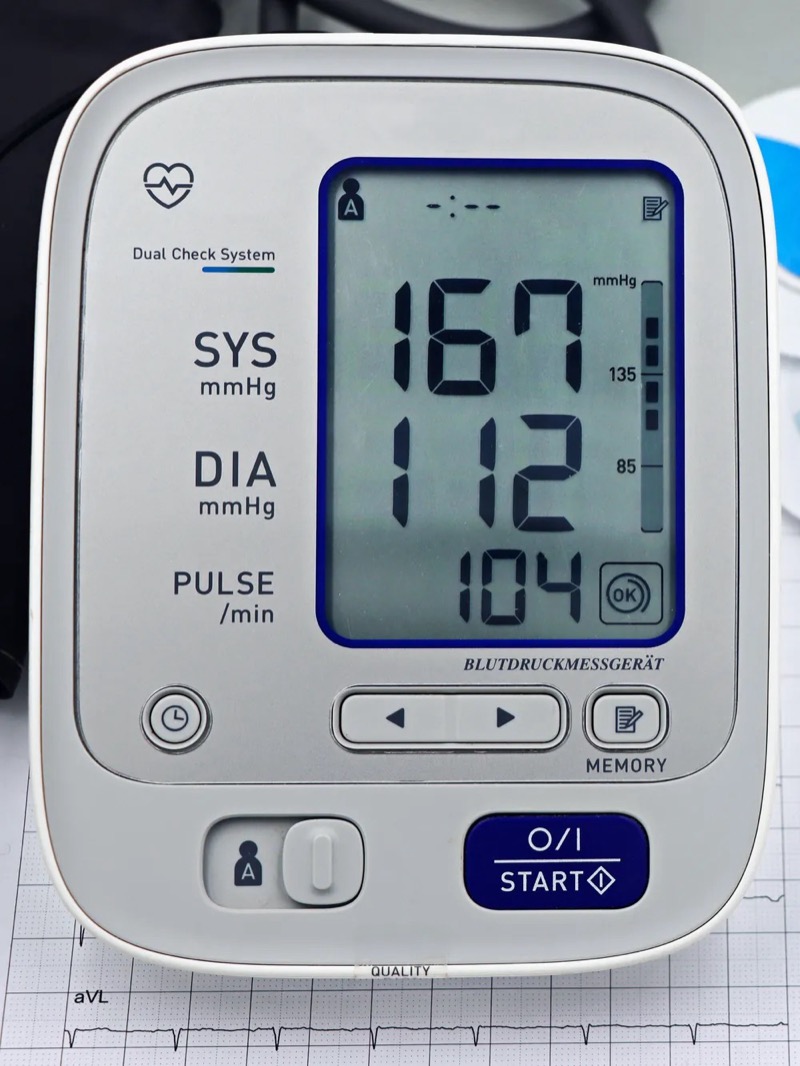
A doctor records a blood pressure reading for a patient wearing a cuff.An electronic blood pressure monitor displaying a reading.

Original publication: Stergiou GS, Palatini P, Parati G, et al. — recommandations ESH 2021 sur la mesure de la tension au cabinet et à domicile, J Hypertens, 2021

HOME BLOOD PRESSURE MONITORING

Do I have high blood pressure?

This tool guides you through a 3-day home blood pressure monitoring protocol, taking several readings each morning and evening (the rule of three) after 5 minutes of rest. It is intended for anyone wanting to check their blood pressure at home, whether or not they are on treatment. The result classifies your average blood pressure into several levels, from normal to grade 1 or grade 2 hypertension, or values (180/110 mmHg or above) that call for medical advice the same day.

Complete and interpret your 3-day home blood pressure monitoring log, based on your country's medical guidelines.

3 days · morning and evening readings · Free, no sign-up

Please read before you start: this guidance tool does not replace a medical consultation. It does not provide a diagnosis.

  • A low or normal result does not rule out the need to see a doctor if you have another symptom that this specific test does not cover.
  • Depending on your age or the guidelines in your country, a consultation may still be advisable even with a negative result.

Before you start

Who is it for?

Any adult who wants to check their blood pressure at home: for an initial screening, or to monitor treated hypertension, at their doctor's request.

What you'll need

a validated blood pressure monitor, ideally an upper-arm model, and 3 days (rule of three).

What you'll get

an average blood pressure reading, interpreted using your country's thresholds.

How to read your result

The result classifies your average blood pressure into several levels, from normal to grade 1 or grade 2 hypertension, or values (180/110 mmHg or above) that call for medical advice the same day.
If you have chest pain, shortness of breath, difficulty speaking, or vision problems, call your local emergency number.

No sign-up, nothing saved on a serverContent based on medical studies

You might also be interested in

Home blood pressure monitoring in a few words

Read the article ▾

Why 3 days, not a single reading?

A single blood pressure reading, especially one taken at a doctor's office, is affected by the stress of the visit ("white coat effect") and by the natural variability of blood pressure throughout the day. Health authorities recommend the "rule of 3": 3 consecutive days, 3 readings in the morning and 3 in the evening, to get an average over 18 readings that is far more reliable than a single measurement.

One protocol everywhere, a threshold that differs by country

Unlike other tools on this site, the measurement and the home blood pressure monitoring protocol are identical worldwide. Only the threshold used to interpret the average changes depending on the guidelines in force in your country:

  • France / Europe (HAS, SFHTA, ESC 2024): hypertension from a home-monitoring average of 135/85 mmHg.
  • United States (AHA/ACC 2017, confirmed by the 2025 update): a lower threshold, with an intermediate "stage 1" tier starting at 130/80 mmHg, then "stage 2" from 140/90 mmHg.
  • Rest of the world (WHO/HEARTS): a clinical threshold of 140/90 mmHg, which corresponds to the equivalent of the European threshold once translated to home monitoring — this tool therefore applies the same interpretation grid as the France/Europe branch for this region.

In practice, the same average of 133/82 mmHg can be classified as "normal" in France and "stage 1 hypertension" in the United States: this is not an error, just two different diagnostic thresholds. Comparing a result from here with one read elsewhere only makes sense if you selected the same reference country.

An emergency to know about, regardless of your region

Above an average of 180/110 mmHg, this is no longer a routine screening result to discuss at a future appointment: it is a potential hypertensive emergency, which warrants prompt medical attention, whichever branch you selected.

Your readings stay on your device

Like every tool on this site, no reading is ever sent to a server. One nuance is worth spelling out clearly: unlike the other tests on this site (calculated once, nothing kept afterward), this one needs to remember your entries from one day to the next so you can resume the protocol without re-entering everything. This data stays stored locally in your browser, only on this device, never transmitted nor accessible to anyone else — you can erase it at any time with the button provided for that purpose.

The link with cardiovascular risk

High blood pressure is one of the main modifiable cardiovascular risk factors. If this log confirms elevated blood pressure, our "What is my cardiovascular risk?" tool lets you estimate your overall 10-year risk.


Frequently asked questions

Why does the threshold change depending on the country?

US guidelines (AHA/ACC) lowered the diagnostic threshold compared to European and French guidelines (HAS, SFHTA, ESC): the same reading can therefore be classified differently depending on the selected country.

Are my readings sent to a server?

No. They stay on your device, in your browser, for as long as it takes to complete the 3 days. They are never transmitted nor accessible to anyone else, and you can erase them at any time.

What should I do if my average is above 180/110 mmHg?

These values call for medical advice the same day.
If you have chest pain, shortness of breath, difficulty speaking, or vision problems, call emergency services immediately.

Sources

  • Haute Autorité de Santé (French National Authority for Health) — guidance on home blood pressure monitoring and the "rule of 3".
  • Société Française d'Hypertension Artérielle (SFHTA) — home blood pressure monitoring guidelines.
  • Mancia G, et al. "2023 ESH Guidelines for the management of arterial hypertension," and the 2024 ESC/ESH update.
  • Whelton PK, et al. "2017 ACC/AHA/AAPA/ABC/ACPM/AGS/APhA/ASH/ASPC/NMA/PCNA Guideline for the Prevention, Detection, Evaluation, and Management of High Blood Pressure in Adults." Hypertension. 2018;71(6):e13-e115.
  • World Health Organization — HEARTS technical package, diagnostic thresholds for arterial hypertension.

Last updated: September 19, 2026.

Reviewed by Dr BARTHELEMY Pierre L., general practitioner

What else would you like to check today?

My cardiovascular prevention profile

Free check-up, no sign-up

A short questionnaire, then the tests that are useful for you, and a results page to show your doctor.

Start my profile →
A doctor explaining a document to a patient during a consultation.

Learn and understand

Hygietest Blog

All articles

58 articles sorted by topic, written from medical guidelines.

Why Hygietest?

Hygietest is a health hub dedicated to primary care, centered on prevention. The idea is simple: bring together, in one place, several screening tools accessible to everyone, to help each person better understand their health even before seeing a doctor.

Multiple tools, focused on prevention

The site is gradually offering several screening tools, covering prevention in general and cardiovascular health in particular — two areas where catching an early signal often changes what comes next: sleep, blood pressure, weight, chronic fatigue. Each tool is designed for one-off use, with no account and no tracking over time.

Simple tools, built on serious foundations

Each questionnaire is based on studies from the medical literature — both established and recent — already used in clinical practice. Hygietest's job is to make them accessible: the same method, the same rigor, but language designed to be understood without any medical training.

Free, with no personal data collection

Hygietest is entirely free. No identity is requested, no payment details, no account creation. Calculations happen directly in your browser: nothing is transmitted, nothing is stored.

What Hygietest is not

Hygietest does not replace, and is not intended to replace, a medical consultation — whether as part of a screening approach or when symptoms appear. A reassuring result never rules out the possibility of seeing a doctor: if doubt remains, or if a symptom not covered by the test worries you, talking to a healthcare professional remains the right approach.

Screening is not diagnosing

This is an important distinction, often misunderstood: a screening tool doesn't serve the same purpose as a diagnostic test. Its main value lies in its ability to flag a risk — its sensitivity — rather than to confirm a diagnosis with certainty, which is the role of specificity and further testing carried out by a doctor. A positive result on a screening test is therefore not a diagnosis: it's an indication that it's worth discussing with a healthcare professional, who will decide whether further tests are needed.

Our goal

Hygietest is purely a tool for making screening more accessible, designed as a complement — never a substitute — to the usual care pathway. The ultimate goal is simple: promote screening to support prevention, by increasing the likelihood that people take the step of seeing a doctor when it's useful to do so.

Frequently asked questions
Is Hygietest free?

Yes. Every test is free, with no sign-up required.

Who is behind Hygietest?

The site is offered and reviewed by Dr. BARTHELEMY Pierre L., a general practitioner. The tests weren't invented for the site: they are scores published in medical journals and recommended by health authorities.

Are the tests reliable?

Each tool reuses the questions, formulas, and thresholds from the original publication. Sources are cited on every page. Like any screening test, they estimate a risk: they don't confirm or rule out a disease.

Can a test replace a medical consultation?

No. A low result doesn't rule out seeing a doctor if a symptom worries you, and a high result is a reason to discuss it with your doctor. In an emergency, call your local emergency number.

What happens to my answers?

Nothing: calculations happen in your browser. No answer is transmitted to or stored by Hygietest. The site measures its audience anonymously and in aggregate (page views, country, device type), without cookies, via Vercel; your test answers are never included.

Which tests are offered?

Fourteen tests: cardiovascular risk (SCORE2), cardiovascular risk with diabetes (SCORE2-Diabetes), high blood pressure (home blood pressure monitoring), diabetes risk (FINDRISC), overweight and obesity (BMI), fatty liver disease (FLI), liver fibrosis (FIB-4), sleep apnea (STOP-BANG), sleepiness (Epworth Sleepiness Scale), nicotine dependence (Fagerström test), alcohol consumption (AUDIT-C), physical activity (IPAQ/GPAQ), burnout (CBI), and depression (PHQ-9).

Which test should I start with?

If you don't have a specific question in mind, start with cardiovascular risk and blood pressure: the two most useful markers in prevention.

A doctor talking with a patient during a consultation.